Shipbuilding at Bridport Harbour
From wooden sailing ships to the busy shipyard of Bridport Harbour
For more than a century, Bridport Harbour – now known as West Bay – was an important centre of shipbuilding. A shipyard was established to the west of the harbour, with several slipways running down to the water.

Between 1769 and 1879, 353 vessels were built at West Bay, ranging from frigates, cutters and schooners to brigantines, barques and fishing smacks.
The vessels built here were valued for their speed and quality, and shipbuilding became an important part of working life around the harbour. At its busiest, the shipyards employed more than 300 people.
Bridport Harbour
Shipbuilding was only one part of the activity at Bridport Harbour. The port served not only Bridport but also Beaminster, Crewkerne, Chard, Yeovil and Sherborne. The quay was a busy scene of loading and unloading, with carts and wagons carrying goods to and from the harbour.
Bridport’s industries were closely connected with overseas trade. Rope, sailcloth, nets, butter and cheese were among the goods exported, while imports included coal, timber, hemp and flax, fruit and wine.

The local rope and netting industry was particularly important. Bridport-made nets found a strong market in the Newfoundland fishing industry, and several of the later vessels built at Bridport Harbour were constructed for Bowering Brothers of St John’s, Newfoundland.
⚓ Discover the story of shipbuilding at West Bay Discovery Centre
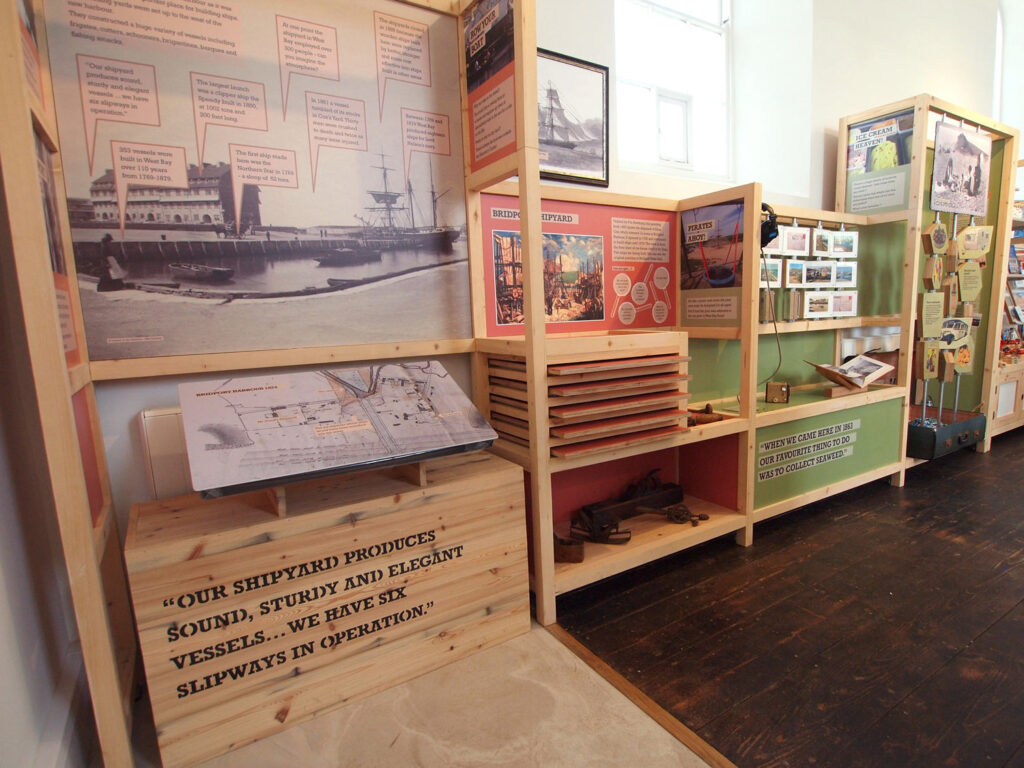
One thing that surprises our visitors (and there’s quite a few!) is that West Bay had such an important shipbuilding industry. Until we opened in 2018 there was very little in West Bay to show that it had been a major ship building centre. Our permanent shipbuilding display includes interactive maps, films, historic photographs, Fra Newbery’s painting and original shipbuilding tools.
- Explore the harbour find out where the shipyards stood and discover the different types of vessels built at West Bay.
- Watch how a ship was built and watch a historic ship launch.
- Look closely Explore historic images of vessels visiting Bridport Harbour.
- Get hands-on see some of the tools used by shipbuilders.
- Dig Deeper our exhibition Down the Slipway – Shipbuilding in West Bay explored the ships, shipyard and people behind Bridport Harbour’s shipbuilding story. The research gathered for the exhibition is preserved in onr of our exhibition folders and can be viewed at the Discovery Centre.
Take a walk around the harbour
- Follow the Salty Sea Dogs trail and discover more about West Bay’s maritime history.
- Join one of our weekly guided walks around West Bay.
- You can also explore the harbour independently with the River Loop guide, following the route and learning more about the harbour and its history.
Ships built at Bridport Harbour
The shipyards produced an extraordinary variety of vessels. The largest was the Speedy, a clipper ship built in 1850. She measured 1,022 tons and 200 feet in length.
Did you know?
The Speedy was approximately the same length as Pier Terrace today. Her masts would have reached to around the height of the building.
During the Napoleonic Wars, 18 ships were built at Bridport for the Royal Navy, when private shipbuilders were called upon to help meet the demand for vessels.

Reconnecting with the past – one of our visitors had a family connection to the Speedy read their story here.
What happened to the ships built here?
Not every ship built at Bridport Harbour had a long or peaceful life. Read the story of the Titania, built here in 1850 and lost at sea in 1865.
The people behind the shipyards
Several local families played important roles in the development of shipbuilding at Bridport Harbour, including the Bools, Good and Cox families.
The end of shipbuilding
The shipyard eventually closed in 1885, as wooden sailing vessels were increasingly replaced by iron ships, which could be built more efficiently elsewhere. This brought to an end more than a century of shipbuilding at Bridport Harbour.
